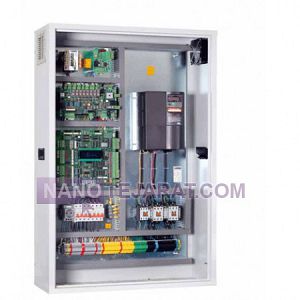
elevator control panel Iran
Cellphone / Whatsapp: +989122003350
| paar-control |
| Iran |
| 021-22976101-5 |
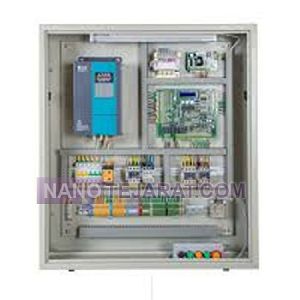
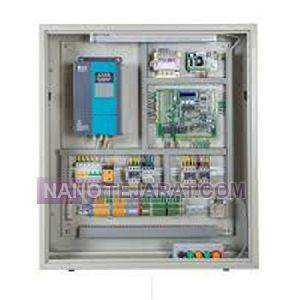
elevator control panel
An elevator electrical panel is a power distribution and protection assembly that manages incoming three phase energy for motors, drives, and auxiliary equipment. Rated input voltage is typically 380 to 400 volts AC with nominal current between 32 and 200 amperes. Copper busbars with purity above 99 percent and cross sections from 15 to 60 square millimeters are selected to withstand short circuit currents up to 15 kiloamperes. The main switch is generally an MCCB with breaking capacity from 25 to 65 kiloamperes. Metal enclosure protection ranges from IP31 to IP55 with sheet thickness between 1.5 and 2 millimeters. Insulation resistance exceeds 100 megaohms at 1000 volts DC testing.
The structure includes DIN rails, power contactors, thermal and magnetic protective relays, and industrial class B terminals. Internal wiring uses stranded copper cables with cross sections from 1.5 to 50 square millimeters. Permissible temperature rise at connection points is limited to 40 degrees Celsius above ambient. A grounding system with resistance below 2 ohms is mandatory for operational safety. Quality tests include 2 kilovolt dielectric testing, earth continuity verification, and functional assessment of protective devices. Design service life under standard operating conditions exceeds
 | |
| paar-control | 021-22976101-5 |
| paar-control |
| Iran |
| 021-22976101-5 |
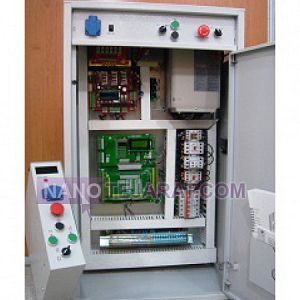
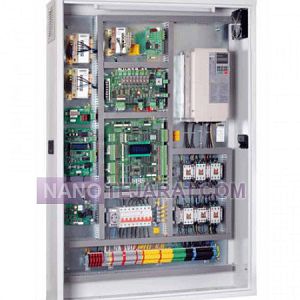
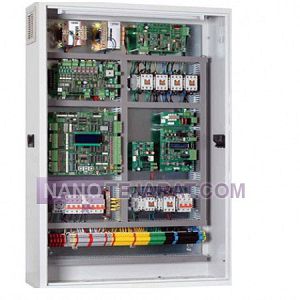
elevator control panel
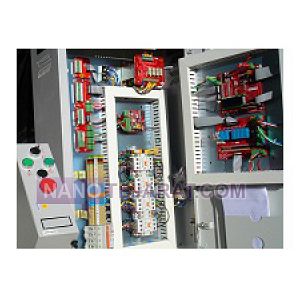
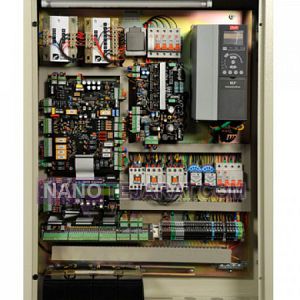
An elevator control panel is an intelligent control unit designed to manage motion, smooth acceleration, soft stopping, and safety circuit supervision. Standard input voltage is 380 to 400 volts AC three phase with 24 volts DC control supply. Variable frequency drive power typically ranges from 7.5 to 90 kilowatts with efficiency above 95 percent. Rated inverter output current is designed between 20 and 200 amperes. Speed control is achieved through closed loop vector algorithms using encoder feedback from 1024 to 2048 pulses per revolution. Cabin stopping accuracy under rated load is maintained within ±1.5 millimeters.
The structure includes a 32 bit processor based main board operating at 120 to 300 megahertz, an IGBT drive module, and dual safety contactors. Metal enclosure protection ranges from IP20 to IP54 with sheet thickness between 1.5 and 2 millimeters. Insulation resistance between power circuits and chassis exceeds 100 megaohms at 1000 volts DC testing. Protective features include overcurrent, short circuit, phase loss, encoder fault, and motor overtemperature detection. Operating temperature range is defined from minus 10 to plus 55 degrees Celsius. Quality validation includes full functional testing, static load trials, and electromagnetic compatibility EMC asse
 | |
| paar-control | 021-22976101-5 |
| paar-control |
| Iran |
| 021-22976101-5 |
elevator control panel
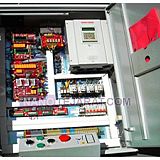
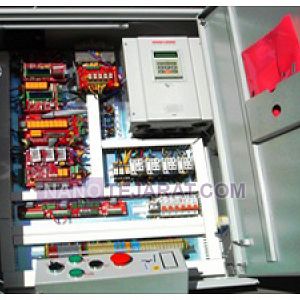
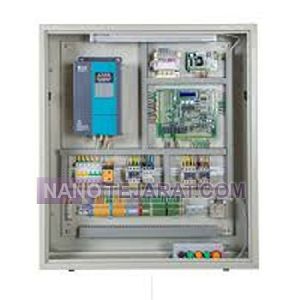
An elevator control panel is the central processing and control unit responsible for motion management, leveling accuracy, and safety circuits in traction and hydraulic systems. Standard input voltage is 380 to 400 volts AC three phase with 24 volts DC control supply. A VVVF drive rated from 7.5 to 55 kilowatts provides smooth speed regulation and reduced mechanical shock. Inverter output current ranges between 20 and 150 amperes depending on capacity. A 32 bit processor operating at 100 to 300 megahertz handles encoder feedback and safety sensor signals. Cabin stopping accuracy is maintained within ±2 millimeters through closed loop control.
The structure includes a main control board, drive module, dual safety contactors, and a switching power supply with efficiency above 85 percent. Metal enclosure protection ranges from IP20 to IP54 with sheet thickness between 1.5 and 2 millimeters. Insulation resistance between power circuits and chassis exceeds 100 megaohms at 1000 volts DC test. Protective systems cover overcurrent, short circuit, phase loss, and motor temperature monitoring. Operating temperature is defined from minus 10 to plus 55 degrees Celsius. Quality validation includes full functional testing, rated load trials, and electromagnetic compatibility EMC assessment
 | |
| paar-control | 021-22976101-5 |
| paar-control |
| Iran |
| 021-22976101-5 |
elevator control panel
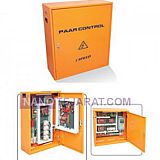
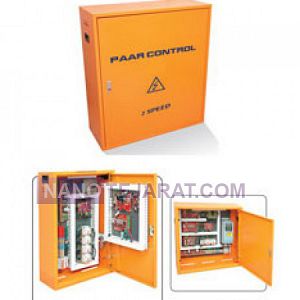
An elevator electrical panel is a power distribution and control assembly that manages incoming energy for motors, drives, and safety devices. Rated input voltage is typically 380 to 400 volts AC three phase with nominal current from 25 to 160 amperes. Copper busbars with cross sections of 10 to 50 square millimeters are selected to withstand short circuit currents up to 10 kiloamperes. The main switch is generally an MCCB with breaking capacity between 25 and 50 kiloamperes. Metal enclosure protection ranges from IP31 to IP54 with epoxy powder coating thickness of 60 to 90 microns. Insulation resistance exceeds 100 megaohms at 1000 volts DC testing.
The structure includes DIN mounting rails, power contactors, protective relays, and standard terminals with class B thermal rating. Internal wiring uses stranded copper cables with cross sections from 1.5 to 35 square millimeters. Permissible temperature rise at connection points is limited to 45 degrees Celsius above ambient. Grounding system resistance below 2 ohms is required for electrical safety. Quality tests include earth continuity verification, dielectric strength testing, and functional assessment of protective switches. Design service life under standard operating conditions exceeds 15 years.
 | |
| paar-control | 021-22976101-5 |
| paar-control |
| Iran |
| 021-22976101-5 |
elevator control panel
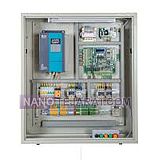
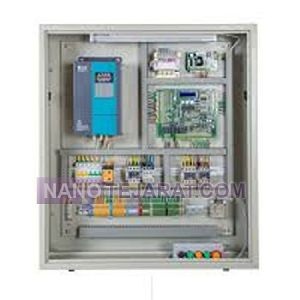
An elevator control panel is the central unit responsible for managing cabin motion, door operation, and safety circuits in traction and hydraulic systems. Standard input voltage is 380 to 400 volts AC three phase at 50 hertz. A 24 volt DC control power supply rated between 100 and 500 watts feeds the command circuits. A VVVF drive rated from 5.5 to 75 kilowatts enables speed control from 0 up to 2.5 meters per second. Inverter output current ranges between 18 and 180 amperes depending on system capacity. Cabin leveling accuracy is maintained within ±2 millimeters using incremental encoder feedback.
The structure includes a 32 bit processor based main board, drive module, dual safety contactors, and protective relays. Metal enclosure protection ranges from IP20 to IP54 with sheet thickness between 1.5 and 2 millimeters. Insulation resistance between power circuits and chassis exceeds 100 megaohms at 1000 volts DC testing. Protective functions cover overcurrent, short circuit, phase loss, overheating, and overspeed monitoring. Operating temperature range is defined from minus 10 to plus 55 degrees Celsius. Quality assurance includes full functional testing, rated load verification, and electromagnetic compatibility EMC evaluation.
 | |
| paar-control | 021-22976101-5 |
| paar-control |
| Iran |
| 021-22976101-5 |
elevator control panel
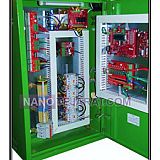
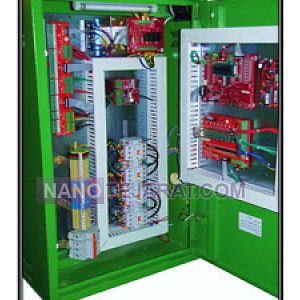
An elevator control panel is the central unit responsible for motion control, safety management, and signal processing in traction and hydraulic systems. Input voltage is typically 380 to 400 volts AC three phase at 50 or 60 hertz. A VVVF drive rated between 5 and 45 kilowatts ensures smooth acceleration and deceleration. Inverter output current ranges from 15 to 120 amperes depending on system capacity. The main processor operates on a 32 bit microcontroller with clock frequency between 72 and 200 megahertz. Cabin stopping accuracy is maintained within ±3 millimeters using encoder based feedback algorithms.
The structure includes a main control board, drive module, safety contactors, and a 24 volt DC switching power supply. Metal enclosure protection is generally rated between IP20 and IP54 with sheet thickness of 1.5 to 2 millimeters. Insulation resistance between phase and chassis exceeds 100 megaohms at 1000 volts DC test. Protective systems include overload relays, short circuit protection, and phase monitoring circuits. Operating temperature range is defined from minus 10 to plus 55 degrees Celsius. Quality assurance involves full functional testing, rated load trials, and electromagnetic compatibility EMC evaluation.
 | |
| paar-control | 021-22976101-5 |
| datis-elevator |
| Iran |
| 021-88337571 |
 | |
| datis-elevator | 021-88337571 |
| datis-elevator |
| Iran |
| 021-88337571 |
 | |
| datis-elevator | 021-88337571 |
| paya-elevator |
| Iran |
| 021-22874939 |
 | |
| paya-elevator | 021-22874939 |
| datis-elevator |
| Iran |
| 021-88337571 |
 | |
| datis-elevator | 021-88337571 |
| paya-elevator |
| Iran |
| 021-22874939 |
 | |
| paya-elevator | 021-22874939 |
| datis-elevator |
| Iran |
| 021-88337571 |
 | |
| datis-elevator | 021-88337571 |
| paya-elevator |
| Iran |
| 021-22874939 |

 | |
| paya-elevator | 021-22874939 |
| paya-elevator |
| Iran |
| 021-22874939 |
 | |
| paya-elevator | 021-22874939 |
| paya-elevator |
| Iran |
| 021-22874939 |
 | |
| paya-elevator | 021-22874939 |