| Exporter, Wholesale, Manufacturer | |
| Isfahan |  |
| +989122003350 | |

- Price :negotiated
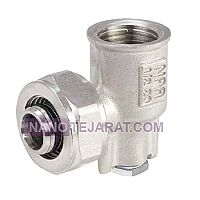
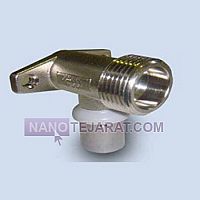
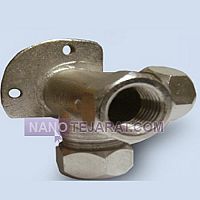
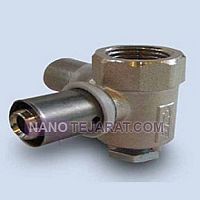
press clamping fitting , Iran
- Price :To negotiate
- order by whatsapp
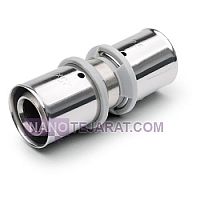
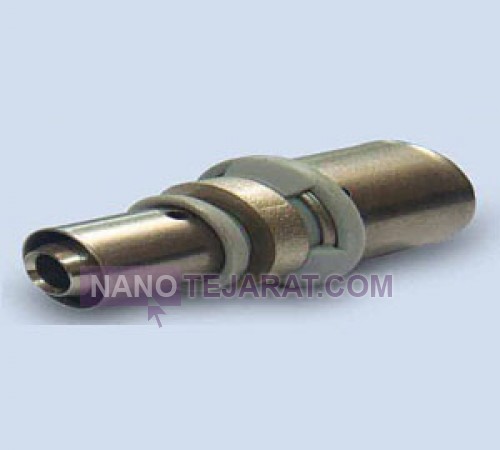
A press reducing coupling is a straight transition fitting designed to change pipe size in cold and hot water systems. The body is manufactured from low lead forged brass with tensile strength between 350 and 500 megapascals. Nominal working pressure ranges from 10 to 16 bar, with test pressure up to 24 bar. Common size combinations include 16 to 20, 20 to 25, and 25 to 32 millimeters. Operating temperature ranges from 0 to 95 degrees Celsius with peak tolerance up to 110 degrees Celsius. The internal design ensures pressure drop below 0.2 bar at nominal flow rate.
The component structure includes two press sockets with stainless steel sleeves and high temperature resistant EPDM O rings. Body wall thickness ranges from 3 to 6 millimeters to withstand internal pressure stress. Sealing is achieved through controlled pipe deformation and uniform O ring compression. Dimensional tolerance in the press area is maintained below ±0.05 millimeter. Nickel plating thickness from 8 to 20 microns enhances corrosion resistance. Quality control includes hydrostatic testing, pull out resistance testing of press joints, and precise dimensional inspection.You can order and buy press clamping fitting from Iran by contacting us through whatsaap and email.
WEBSITE: press clamping fitting Iran
Types of Press Reduction Couplings Based on Size and Material in iran
Press reduction couplings are classified according to nominal pipe diameter and alloy composition, and are designed to securely connect two different pipe sizes. Common plumbing sizes include 16 to 20, 20 to 25, 25 to 32, and up to 63 millimeters. In industrial applications, the size range can extend from 75 to 110 millimeters. In terms of material, CW617N brass alloy, stainless steel 304 and 316, and engineering polymer PPSU are most widely used. Permissible working pressure varies between 10 and 25 bar, while operating temperature ranges from minus 20 to 95 degrees Celsius. Proper size and material selection must comply with ISO 21003 and DIN 8076 dimensional standards. This directly affects sealing performance, corrosion resistance, and service life exceeding 50 years.