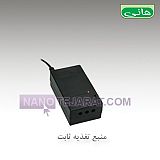
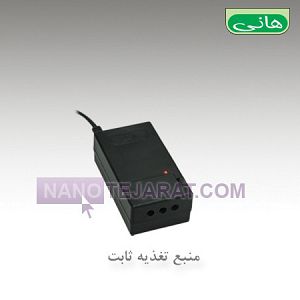
Fixed power supply
A linear regulated power supply utilizes a low-frequency transformer with 85-90% efficiency. These units typically provide fixed DC outputs of 5, 12, 15, 24, or 48 volts. Voltage regulation is achieved via BJT or MOSFET power transistors. The output ripple factor is usually less than 5 mV RMS. Broadband noise also generally remains below 1 mV peak-to-peak. Load regulation is within 0.1% for loads between 10% and 100%. Line regulation is typically 0.05% for ±10% AC input variations. The output current of standard models ranges from 1 to 30 amperes. The permitted operating temperature is often between 0 and 40 degrees Celsius. These units commonly feature short-circuit and thermal protection.
The internal structure consists of a bridge diode rectifier, a high-capacitance filter typically 10,000-47,000 µF, and a series regulator circuit. Electrolytic capacitors with a minimum lifespan of 2000 hours at 105°C are used. Regulation is performed by integrated regulators like the LM78xx series or discrete circuits with precision op-amps. The systems transient response is typically under 50 microseconds for a 50% sudden load change. Heat dissipation can reach 30-60 watts in high-power models. Extruded aluminum heat sinks with a thermal resistance of 1-2 °C/W dissipate this heat. Ove