



| Exporter, Wholesale, Manufacturer | |
| Tehran |  |
| +989122003350 | |

- Price :negotiated
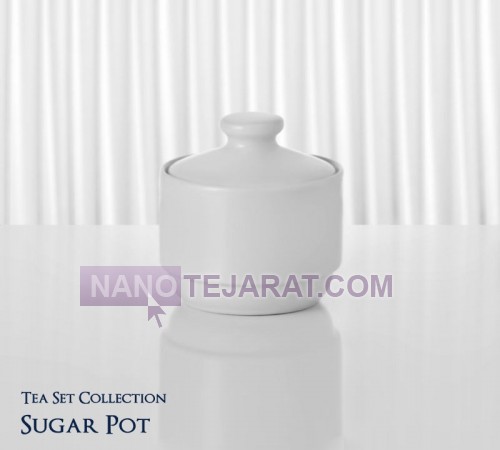
restaurant porcelain-sugar pot , Iran
- Price :To negotiate
- order by whatsapp
The restaurant porcelain sugar bowl is manufactured from feldspathic porcelain with water absorption below 0.5 percent and density between 2.3 and 2.6 grams per cubic centimeter. Firing temperature is controlled within 1280 to 1400 degrees Celsius, providing flexural strength above 95 megapascals. Wall thickness is designed between 3 and 5 millimeters to enhance impact resistance and durability in commercial use. A hygienic glaze with surface hardness above 6 on the Mohs scale and chemical resistance against alkaline detergents is applied. Dimensional tolerance is maintained within ±1 millimeter and color uniformity complies with ISO 13006 standards. Unit weight varies from 150 to 350 grams depending on capacity.
The structure includes a cylindrical or spherical body with capacity from 150 to 400 milliliters and a precisely fitted lid. Lid clearance is controlled below 0.5 millimeter to limit moisture exchange. The inner rim is reinforced with curvature radius of 2 to 4 millimeters to reduce stress concentration. Thermal resistance is guaranteed from minus 20 to plus 200 degrees Celsius. The base features a foot ring with diameter between 4 and 8 centimeters for improved stability. Quality evaluation includes thermal shock testing, rim impact testing, and compatibility assessment with industrial dishwashers.You can order and buy restaurant porcelain-sugar pot from Iran by contacting us through whatsaap and email.
WEBSITE: restaurant porcelain-sugar pot Iran
Production Standards for Restaurant Porcelain Tableware in iran
Restaurant porcelain tableware is manufactured using a precise composition of kaolin, feldspar, and silica with purity above 95 percent. The common raw material ratio is approximately 50 percent kaolin, 25 percent feldspar, and 25 percent silica. Forming is carried out by isostatic pressing or slip casting to achieve uniform density above 2.3 grams per cubic centimeter. Biscuit firing occurs at 900 to 1000 degrees Celsius, followed by final firing at 1250 to 1400 degrees Celsius. Water absorption must remain below 0.5 percent, and thermal shock resistance should withstand at least a 120 degree Celsius temperature difference. Glaze surface hardness is set at minimum 6 on the Mohs scale. Impact resistance testing requires at least 0.5 joules per piece. Quality control includes chip resistance, glaze uniformity, and dimensional tolerance within 2 percent.

restaurant porcelain-salt

restaurant porcelain- big jug
restaurant porcelain- bowl

restaurant porcelain- long plate

restaurant porcelain- German Mug

restaurant porcelain- vase

restaurant porcelain- small jug

restaurant porcelain- Russian Mug

restaurant porcelain- mug
restaurant porcelain - kebab platter 39