


| Exporter, Wholesale, Manufacturer | |
| Tehran |  |
| +989122003350 | |

- Price :negotiated
hotel porcelain - Breakfast Dish , Iran
- Price :To negotiate
- order by whatsapp
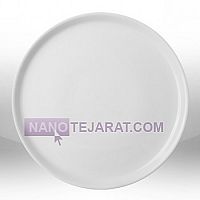
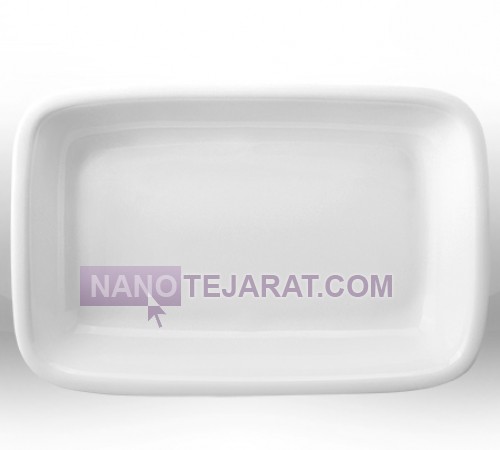
Hotel porcelain breakfast platters are manufactured from feldspathic porcelain with water absorption below 0.5 percent and a dense microstructure. The firing process is carried out at temperatures between 1350 and 1400 degrees Celsius. Final density ranges from 2.3 to 2.5 grams per cubic centimeter. Flexural strength is at least 90 megapascals, and compressive strength exceeds 400 megapascals. A transparent glaze layer with thickness of 0.2 to 0.4 millimeters is applied. Common dimensions are designed within 250 to 400 millimeters in length and 150 to 250 millimeters in width.
The structure is typically oval or rectangular with reinforced rims to improve resistance against edge chipping. Base thickness is generally selected between 5 and 7 millimeters to ensure uniform load bearing capacity. Thermal shock resistance is evaluated within a temperature differential of 120 to 160 degrees Celsius. The glazed surface exhibits hardness around 6 on the Mohs scale and chemical resistance within a pH range of 2 to 11. Dimensional tolerance for length and width is usually maintained within ±3 millimeters. Quality control includes rim impact testing, water absorption measurement, and glaze uniformity inspection.You can order and buy hotel porcelain - Breakfast Dish from Iran by contacting us through whatsaap and email.
WEBSITE: hotel porcelain - Breakfast Dish Iran
Evaluation of Glaze Quality and Production Standards for Porcelain Breakfast Plates in iran
To evaluate glaze quality of porcelain breakfast plates, the coating must be uniform, free of bubbles, cracks, and discontinuities to create a smooth, non-porous surface. Standard glaze hardness should be at least 6 on the Mohs scale to resist scratches from cutlery. Water absorption below 0.5 percent indicates proper firing at 1250–1300 degrees Celsius, enhancing surface strength and stain resistance. Dimensional tolerance should be below 2 percent to ensure consistent table set alignment. In thermal shock testing, the plate should withstand temperature differences of 80–100 degrees Celsius without cracking. Chip and impact resistance are checked with a drop test from 60 centimeters onto a wooden surface to ensure durability in daily service.