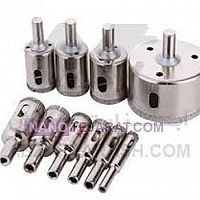



 4 site_250_150.jpg "Diamond Blade Arbor")
| Exporter, Wholesale, Manufacturer | |
| Tehran |  |
| +989122003350 | |

- Price :negotiated
Diamond Blade Arbor , Iran
A blade arbor is a high-precision steel adapter connecting the cutting disc to the tool. It is manufactured from C45 carbon steel undergoing surface hardening heat treatment. Its surface hardness reaches 45 to 50 HRC. Its standard outer diameter is 22.23 mm 7/8 inch or 20 mm. Its inner diameter matches the tool spindle, typically M14 or 5/8 inch. Dimensional tolerance on critical surfaces is maintained at IT7 or better. Total arbor length varies from 15 to 50 mm based on the blade diameter. All surfaces are machined with a surface finish better than Ra 1.6 microns.
Its structure consists of a base flange, a central hub, and a locking nut. The base flange has a minimum 3 mm thickness to prevent deflection. The central hub provides at least 10 mm of contact length on the spindle ensuring perfect concentricity. The locking nut is typically made from A2 stainless steel with metric threads M14x1.5 or M14x2. Recommended tightening torque is between 35 and 50 Nm. This design enables uniform load transfer and reduces radial play to under 0.05 mm. Its symmetrical and balanced geometry minimizes vibration at speeds exceeding 10,000 RPM.You can order and buy Diamond Blade Arbor from Iran by contacting us through whatsaap and email.
WEBSITE: Diamond Blade Arbor Iran
Types of Rounding Sequences and the Application of Each
Rounding sequences are rotational sequential operations in numerical computations. The first type, simple rounding sequences, are used for rotating angles within the 0 to 2π range. The second type, residual rounding sequences, enable solving trigonometric equations with high precision. CORDIC rounding sequences are essential in low-power hardware architectures. These sequences efficiently compute functions like sine and cosine. Their primary applications are in digital signal processing and inertial navigation systems. These algorithms create an optimal balance between precision and computational complexity.