


| Exporter, Wholesale, Manufacturer | |
| Tehran |  |
| +989122003350 | |

- Price :negotiated
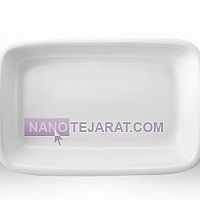
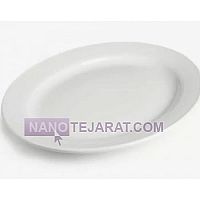
hotel porcelain-Lasagne platter , Iran
- Price :To negotiate
- order by whatsapp
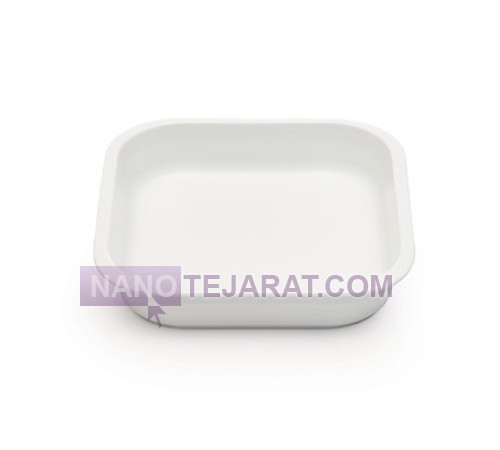
Hotel porcelain lasagna dishes are manufactured from feldspathic porcelain with water absorption below 0.5 percent and a dense microstructure. The firing process is performed at temperatures between 1350 and 1400 degrees Celsius. Final density ranges from 2.3 to 2.5 grams per cubic centimeter. Flexural strength is at least 95 megapascals, and compressive strength exceeds 400 megapascals. A heat resistant glaze layer with thickness of 0.25 to 0.4 millimeters is applied. Typical dimensions are designed within 250 to 400 millimeters in length and 150 to 300 millimeters in width.
The structure is rectangular and deep with reinforced walls and radiused corners. Internal depth usually ranges from 40 to 80 millimeters, and base thickness is selected between 6 and 8 millimeters. Thermal shock resistance is evaluated within a temperature differential of 150 to 200 degrees Celsius. The glazed surface exhibits near zero porosity and chemical resistance within a pH range of 2 to 11. Dimensional tolerance for length and width is generally maintained within ±3 millimeters. Quality control includes oven temperature resistance testing, rim impact evaluation, and glaze uniformity inspection.You can order and buy hotel porcelain-Lasagne platter from Iran by contacting us through whatsaap and email.
WEBSITE: hotel porcelain-Lasagne platter Iran
Heat Resistance of Porcelain Lasagna Dishes in iran
Restaurant grade porcelain lasagna dishes are engineered to withstand high oven temperatures, typically resisting 250 to 300 degrees Celsius. A body thickness of 6 to 10 millimeters ensures uniform heat distribution and reduces the risk of sudden cracking. Standard thermal shock resistance covers a temperature difference of at least 120 degrees Celsius. Water absorption below 0.5 percent prevents moisture penetration and structural weakening during repeated baking cycles. Glaze fired at approximately 1250 degrees Celsius provides surface hardness close to 6 on the Mohs scale. Direct transfer from freezer to oven is not recommended, and gradual temperature change is safer. When properly handled, service life in industrial kitchens can exceed 3 to 5 years.