
| Exporter, Wholesale, Manufacturer | |
| Tehran |  |
| +989122003350 | |

- Price :negotiated
milling machines , Iran
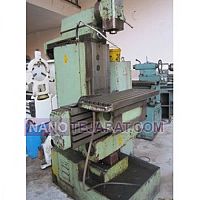
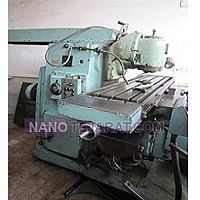
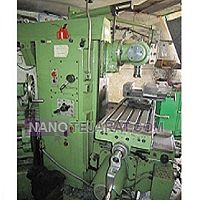
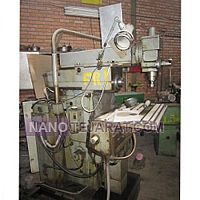
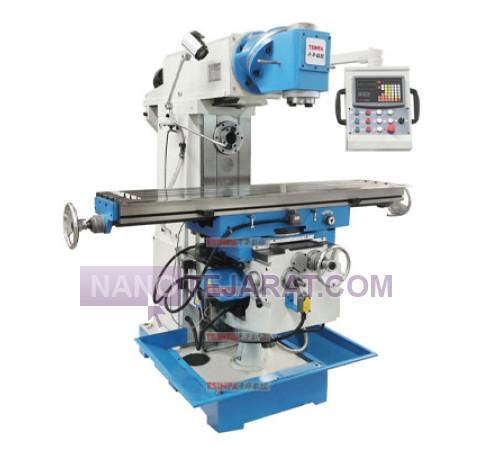
A conventional milling machine is a manual knee type machine tool designed for metal cutting with mechanical control. Main motor power typically ranges from 1.1 to 5.5 kilowatts, and spindle speed varies between 80 and 3000 rpm. Speed adjustment is achieved through a stepped gearbox or belt pulley system. X axis travel ranges from 500 to 1000 millimeters with manual positioning accuracy of approximately ±0.02 millimeter. The spindle taper is commonly ISO40 with axial runout below 0.01 millimeter. Maximum table load capacity is generally between 200 and 600 kilograms.
The structure consists of a gray cast iron body with hardness above 170 Brinell and a stress relieved monolithic column. Motion guideways are ground dovetail slides with adjustable clearance below 0.02 millimeter. Table feed can be manual or powered by a 0.75 kilowatt feed motor. Feed rate range is defined between 20 and 800 millimeters per minute. A coolant system with 25 liter per minute pump is installed to extend tool life. Accuracy testing includes surface roughness down to 1.6 micrometers Ra and spindle perpendicularity deviation below 0.02 millimeter over 300 millimeters.You can order and buy milling machines from Iran by contacting us through whatsaap and email.
WEBSITE: milling machines Iran
Applications of Conventional Milling Machines in Industrial Workshops in iran
Conventional milling machines are widely used in industrial workshops for machining metal parts with an accuracy of 0.02 to 0.05 mm. They perform face milling, slot cutting, chamfering, and precision drilling on steel, aluminum, and cast iron components. Spindle speed adjustment between 60 and 3000 rpm enables controlled material removal. These machines play a key role in manufacturing simple molds, spare parts, and industrial fixtures. The use of end mills, side cutters, and face milling cutters expands operational capability. Manual feed control allows operators to achieve surface roughness values around Ra 1.6 to 3.2 microns. Low maintenance cost and simple mechanical structure make them economical for small and medium workshops. They are also fundamental tools for training in basic machining skills.